Multi-Location Website Management: A Guide for NYC Businesses with Multiple Storefronts

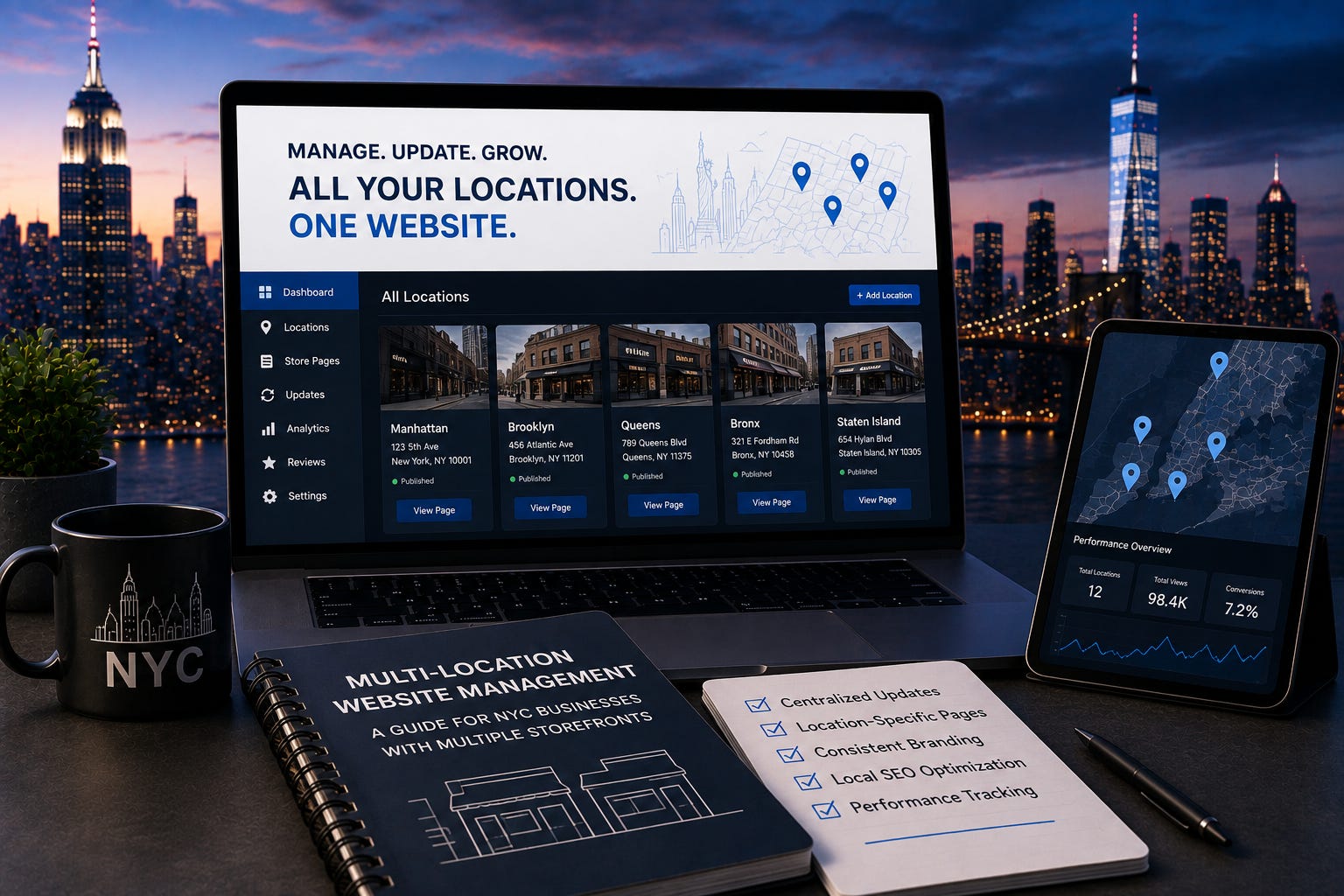
Running one location’s website is manageable. Running five locations’ worth, each needing its own accurate hours, its own local SEO presence, its own review stream, while somehow staying consistent with your overall brand, is an entirely different operational challenge that most multi-location businesses underestimate until they’re already drowning in it. Getting this architecture right from the start is exactly why a website development company in New York businesses trust needs to think in systems, not just individual pages, when working with a multi-location brand.
Why Multi-Location SEO Isn’t Just Single-Location SEO, Repeated
This is the mistake that trips up most growing NYC businesses: multi-location SEO is not simply local SEO repeated multiple times. Every additional location multiplies genuine complexity: more Google Business Profile listings to optimize and actively maintain, more location pages requiring genuinely unique content, more citation profiles to keep consistent across directories, and more separate review streams to actively manage. A strategy that worked cleanly for one location often breaks down entirely once you’re managing five, ten, or more.
The Google Business Profile Stakes Are Higher Than Most Owners Realize
For any multi-location business, Google Business Profile is simultaneously the most valuable and the most operationally demanding local SEO asset you have. Each location needs its own fully optimized profile, a unique phone number, accurate address, correct categories, complete service listings, and active review management, maintained continuously, not set up once and forgotten. The performance data clearly justify this investment: complete Google Business Profiles are 70% more likely to attract location visits than incomplete ones, and 50% more likely to be considered for purchase in the first place. GBP-driven actions, calls, direction requests, website clicks grew 41% year-over-year per location in the most recent data, meaning under-optimized locations are leaving measurable customer interactions on the table with every passing month.
Industry professionals overwhelmingly agree on where the priority sits: 76% of franchise and multi-location marketing professionals rate Google Business Profile management as their single most valuable local SEO activity, ahead of website content, paid advertising, or any other channel.
The Duplicate Content Trap That Quietly Kills Rankings
Here’s a mistake that shows up constantly in multi-location websites: copying the same page template across every location with only the address swapped out. Google actively suppresses location pages with duplicate or thin content; unique, genuinely localized content per location is a structural ranking requirement, not an optional nicety. A location page that reads identically to four other locations’ pages, aside from the address block, signals low effort and low local relevance to search engines, undermining exactly the local visibility multi-location businesses need most.
URL Architecture: The Technical Decision With Outsized Impact
Here’s a genuinely underappreciated technical decision: businesses using a subdirectory structure (yourbrand.com/locations/city-name) generate 2-3x the domain authority compared to businesses running separate individual domains per location, according to a 2026 analysis of multi-location brands. This happens because a subdirectory structure consolidates all of your brand’s overall authority and backlinks into one domain, with each location page benefiting from that shared strength, while separate domains per location essentially start from zero authority each time, forcing every single location to build credibility independently rather than borrowing from your established brand.
Despite this clear advantage, fewer than 30% of individual location pages actually rank in the top-3 local pack for their primary service keyword in their own territory, reflecting how much execution gap exists even among businesses that understand the basic strategy.
Platform Choice Scales With Your Location Count
For businesses managing 5-50 locations, standard platforms like WordPress with proper multisite configuration remain the most cost-effective, practical choice. Once a network grows beyond roughly 100 locations, purpose-built franchise and multi-location CMS platforms genuinely outperform standard WordPress setups; some enterprise platforms manage 300+ brand location networks from a single centralized system, offering location-page templating, centralized brand governance, and bulk update capabilities that become operationally necessary at that scale, even though they cost more than a standard CMS.
The Balance Every Multi-Location Brand Has to Strike
The core operational tension in multi-location marketing is genuinely structural: you need enterprise-level governance, consistent templates, and centralized brand standards, while simultaneously needing authentic, localized content and search signals for each location. Getting this balance wrong in either direction causes real problems: too much centralization produces the thin, duplicate-feeling location pages search engines actively suppress, while too little central governance produces inconsistent branding and duplicated effort across locations that should be sharing infrastructure and learnings.
A Practical Framework for Getting This Right
Build unique, genuinely localized content for every location page, neighborhood references, location-specific services or inventory, and unique photography, rather than a template with only the address changed.
Choose subdirectory architecture over separate domains per location, consolidating your brand’s overall domain authority rather than fragmenting it across multiple weaker domains.
Fully complete and actively maintain a Google Business Profile for every single location, treating this as ongoing operational work, not a one-time setup task.
Implement LocalBusiness schema markup consistently across all location pages; current research shows only about 31% of local business websites have this properly implemented, meaning correct implementation remains a genuine, available competitive advantage.
Centralize your NAP (name, address, phone) data management to prevent inconsistencies from creeping in across directories and citation sources as locations open, close, or change details over time.
FAQs
Should each of my business locations have its own separate domain, or all live under one main domain?
A subdirectory structure under one main domain (yourbrand.com/locations/city) is generally the stronger choice; it consolidates domain authority and backlink value across all locations rather than fragmenting it, which research shows produces better rankings than separate domains per location.
How much unique content does each location page actually need?
Enough to genuinely differentiate it from your other locations, neighborhood-specific references, unique service details, distinct photography, and localized information. Templated pages with only the address changed are actively at risk of being suppressed by search engines as thin or duplicate content.
At what point should I switch from WordPress to a dedicated franchise CMS platform?
Standard WordPress with proper multisite setup remains cost-effective and practical for most businesses in the 5-50 location range. Beyond roughly 100 locations, purpose-built franchise CMS platforms typically become worth their higher cost due to centralized management capabilities that WordPress alone struggles to handle efficiently at that scale.
How important is Google Business Profile compared to my actual website for multi-location businesses?
Extremely important; many local SEO professionals rate it as the single highest-value activity in the entire local marketing stack for multi-location brands, given how directly complete, well-maintained profiles drive location visits and purchase consideration compared to incomplete ones.
What’s the biggest mistake multi-location businesses make with their websites? Using near-identical location page templates with only the address swapped, which search engines increasingly recognize and actively suppress as thin or duplicate content; genuinely unique, localized content per location remains one of the highest-leverage, most commonly skipped fixes.
Bottom Line
Multi-location website management is a fundamentally different challenge than single-location SEO; the complexity multiplies with every additional storefront, and the businesses that handle it well are the ones treating it as a genuine system requiring centralized architecture and localized execution simultaneously, not a template copied and pasted with new addresses. This is exactly the kind of structural planning worth getting right from the start with a website development company in New York businesses trust to build a scalable system, not just another single-location website repeated several times over.